
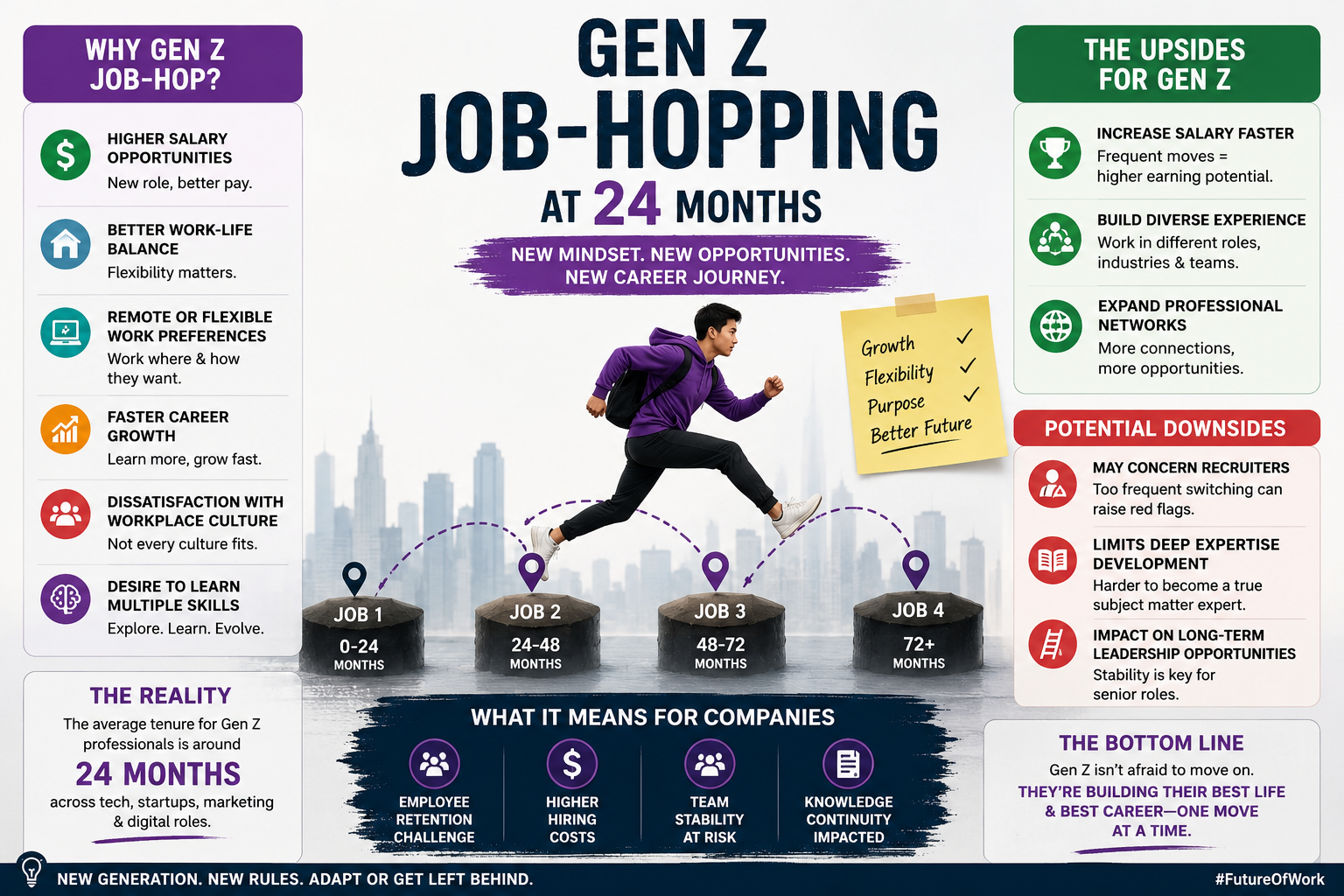

There’s a number that’s quietly alarming every HR leader in Indian tech right now, and most of them are talking around it rather than about it directly.
According to Scaler, “Nearly 40% of all recruitment in India’s GCC ecosystem is now backfilling roles — not creating new ones.”
Four in ten hires aren’t building something. They’re plugging a hole left by someone who already left. And the reason those holes keep appearing? Gen Z employees are now averaging fewer than two years per role, with tenure dropping below the 24-month mark — a threshold that barely covers the time it takes to onboard, train, and get someone to a point where they’re genuinely adding value.
The result is a continuous loop of hiring, training, and losing — and then hiring again. Companies are running harder than ever just to stand still.
Before we call this a “Gen Z problem,” let’s ask a harder question: Is this really about a generation’s attitude toward work, or is it about something far more structural that nobody in boardrooms wants to own?
The Numbers Don’t Lie — But They Don’t Tell the Whole Story Either
According to Randstad’s global survey of 11,250 workers across 15 markets, Gen Z’s average tenure in the first five years of their career is just 1.1 years — significantly shorter than Millennials at 1.8 years, Gen X at 2.8, and Baby Boomers at 2.9.
That’s not an incremental generational shift. That’s a fundamental rewiring of how young people relate to employment.
According to DigWatch, job-hopping has actually lost its compensation edge. The salary difference between people who stay in their jobs versus those who switch has reached its lowest level in a decade. Employees who stayed received a 4.6% wage bump, while switchers received just 4.8% — a 0.2% difference.
In other words, Gen Z isn’t job-hopping for the money anymore. The financial incentive is nearly gone. So what’s driving it?
Randstad’s data is clear: Gen Z is mobile not because of disloyalty, but because of unmet ambition. They seek clear development paths, AI-enabled learning, flexibility, and work that aligns with their values. A full 52% are actively looking for a new role, and only 11% plan to stay in their current job long term.
That’s not a retention failure. That’s a design failure. Companies are building roles that hold people for 18 months and then wonder why people leave at 18 months.
The Replacement Hiring Loop Is Now a Business Risk
Here’s why the 40% backfill figure matters beyond the HR department.
As per Scaler, “India’s GCC ecosystem posted 12–14% quarter-on-quarter growth in Q4 FY2026 — but the headline hiring growth is masking what’s actually happening beneath the surface. The rise in replacement hiring now accounts for 40% of all recruitment activity, and it’s being directly driven by the decline in Gen Z tenure expectations. GCCs are now forced to balance aggressive expansion with the constant need for organizational continuity.”
Think about what that actually costs. Every time a role turns over, there’s recruitment spend, notice periods, onboarding time, ramp-up time, the institutional knowledge that walks out the door, the team productivity dip while someone new finds their footing, and the invisible tax of a manager spending 30% of their week re-explaining context that should already exist.
Conservative estimates put the cost of replacing a mid-level tech professional at 50–200% of their annual salary. At 40% of recruitment being backfill, that’s not an HR problem. That’s a significant, measurable drag on growth efficiency.
And the companies feeling it the hardest? The largest organizations — those with 1,000 to 4,999 employees — report the highest talent shortage rate at 86%, seven points higher than the smallest firms. As per Analytics India Magazine, Scale doesn’t protect you from this loop. It amplifies it.
India’s Real Crisis: Readiness, Not Skills
This is where the conversation gets more complex and more honest.
The India Skills Gap Report 2026 by NIIT argues that India’s workforce is struggling not because people lack degrees, but because they aren’t prepared for how fast jobs are changing.
According to Teract, “India’s skills challenge is no longer about whether people hold qualifications. It is about whether they can perform in roles that are changing faster than the systems preparing them.”
That’s a precise and uncomfortable distinction. We have millions of graduates. We have degree programs. We have certifications. What we don’t have, at sufficient scale, is people who are genuinely ready to step into roles that look fundamentally different from what they did three years ago, and will look different again in two more.
As per Teract, senior professionals rate their own job readiness at 82 out of 100, mid-level workers at 75, and early-career talent at just 68. Students score even lower at 57, reflecting limited exposure to real-world work environments.
That 15-point gap between mid-level and entry-level isn’t just a confidence issue. It’s a structural exposure issue. Only 34% of academic institutions actively integrate AI and digital skills into their curricula, even as 51% of employers view AI as a driver of cost savings and productivity.
The institutions preparing the workforce and the businesses receiving it are operating on completely different timelines.
So, when a Gen Z employee leaves at 18 months, are they being flighty? Or are they leaving because the role they were placed in didn’t match the level they were ready for, the mentorship wasn’t there, the growth path wasn’t visible, and the skills the company actually needed didn’t match what their education had equipped them with?
Both things can be true simultaneously: Gen Z moves fast, and companies are placing underprepared people in underdesigned roles.
The AI Factor: Accelerating Everything, Preparing Nobody
Globally, AI talent demand now exceeds supply by a ratio of 3.2:1, with over 1.6 million open positions and only 518,000 qualified candidates available. In the Asia-Pacific region, in India’s competitive context, the shortage ratio is the highest at 1:3.6, and the average time to fill an AI role is 4.1 months.
According to Analytics India Magazine, in India specifically, 82% of employers reported difficulty filling roles in 2026 — significantly above the global average of 72%. For the first time, AI skills have surpassed all others as the most difficult to find, with AI model development at 39% and AI literacy at 38% topping the list of hard-to-fill requirements.
Now layer that on top of the replacement hiring loop. Companies are already backfilling 40% of roles. The skills they need most are the scarcest in the market. And the generation they’re hiring most is averaging 1.1 years per role.
As per Whalesbook, India leads among 15 surveyed markets in AI adoption velocity — with 40% of Indian enterprises reporting significant or full AI use, well ahead of the global average of 28%. But when it comes to deep technical expertise in next-generation AI, India ranks near the bottom of that same group.
We’re adopting AI faster than anyone. We’re building the expertise to sustain it more slowly than almost anyone. That gap between deployment enthusiasm and institutional depth is precisely where companies find themselves hiring, training, losing, and hiring again — in a loop that’s becoming structurally expensive.
What Gen Z Actually Wants
83% of Gen Z identify as job-hoppers — but four in ten say they always consider their long-term goals when making a job move. The movement is intentional, not impulsive.
Entry-level roles requiring 0–2 years of experience have declined by an average of 29 percentage points globally since January 024 — with junior tech roles specifically down 35%.
Here’s the irony: the generation accused of having no loyalty is increasingly being shut out of the roles where loyalty could be built. Entry-level jobs are disappearing. The roles that remain often don’t offer the mentorship or growth pathways that would make someone want to stay. And when someone leaves at 18 months because they weren’t growing, the company’s response is too often to hire again with the same job design that failed the last person.
Six in ten managers report having fired Gen Z employees within months of hiring them, citing communication gaps, lack of initiative, and poor organization.
But this data deserves examination — because those same managers are operating inside organizations where onboarding is often shallow, feedback is infrequent, and the expectation is that new hires should “figure it out.” That might have worked when someone was staying for five years. It doesn’t work when someone decides in 60 days whether to stay or start looking.
The NIIT report is direct: “Most people are willing to learn. Most organisations are willing to invest. Time expectations are aligned. What is missing is reach.” The constraint in an AI-shaped economy is not motivation — it is access at scale.
Breaking the Loop: What Actually Works
This isn’t a call to romanticize job-hopping or dismiss the real operational cost it creates. The replacement hiring loop is a genuine problem. It’s expensive, disruptive, and it compounds talent scarcity in roles that already have a 4–7 month time-to-fill.
But the companies breaking this loop aren’t doing it by demanding longer tenure commitments or lamenting generational attitudes. They’re doing it by redesigning the relationship between employer and employee from the ground up.
The signals are already shifting: 45% of employers and candidates now rank portfolios of work among the top indicators of readiness, over degrees. Micro-credentials, industry certifications, and apprenticeship experience are rising in value.
The formal-degree-as-qualification model is giving way to a demonstrated-skill model — and companies that update their hiring and development practices accordingly are finding better fit, faster ramp, and longer tenure.
The winning model is hybrid: hire for readiness and potential, not just credentials. Build internal pathways that actually function — not career ladders that only move every three years, but visible growth every six to twelve months. Invest in AI-enabled continuous learning that keeps pace with how fast roles are evolving.
Organizations that solve for AI-ready talent fastest will lead the next decade of growth. The talent exists — but it needs to be reskilled and redeployed. The demand is rising, but traditional hiring models cannot keep up.
The Honest Conclusion
Gen Z isn’t the villain in this story. Neither, entirely, are the companies running the replacement hiring loop.
What we’re witnessing is a collision between a workforce generation shaped by a world of constant, fast-moving change — and organizational structures built for a world where people stayed in one lane for a decade. Neither side was fully prepared for the other.
The 24-month tenure number is a symptom. The readiness gap is the disease. And the cure isn’t about making Gen Z stay longer in roles that don’t grow them — it’s about building roles worth staying in, with pathways visible enough to make leaving feel like the lesser option.
The companies that figure that out in 2026 won’t just solve a retention problem. They’ll stop hemorrhaging the 40% replacement budget on backfill and start actually building the institutional depth that the AI era demands.
The loop doesn’t have to be permanent. But breaking it requires an honest look at what’s creating it — and most of that honest look needs to happen in the boardroom, not in exit interviews.
Timecode Technologies partners with IT companies and GCCs to solve exactly this challenge — connecting businesses with pre-vetted, role-ready talent and reducing the cost of the replacement hiring loop.
Connect with us at timecodeglobal.com!

