

Technology & Workforce | In-Depth Analysis | May 2026 | 8 min read
40% — AI roles globally that cannot be filled with current talent
127% — Rise in AI-related job postings above pre-pandemic baseline
1.4M — Estimated AI specialist shortfall projected by the end of 2026
6 Years — Average time to train a qualified ML engineer from scratch
Every few years, the technology industry convinces itself that it has finally found the thing that changes everything — and then spends the next decade discovering how hard “everything” actually is to change. The internet did it. The cloud did it. Mobile did it. And now, artificial intelligence is doing it.
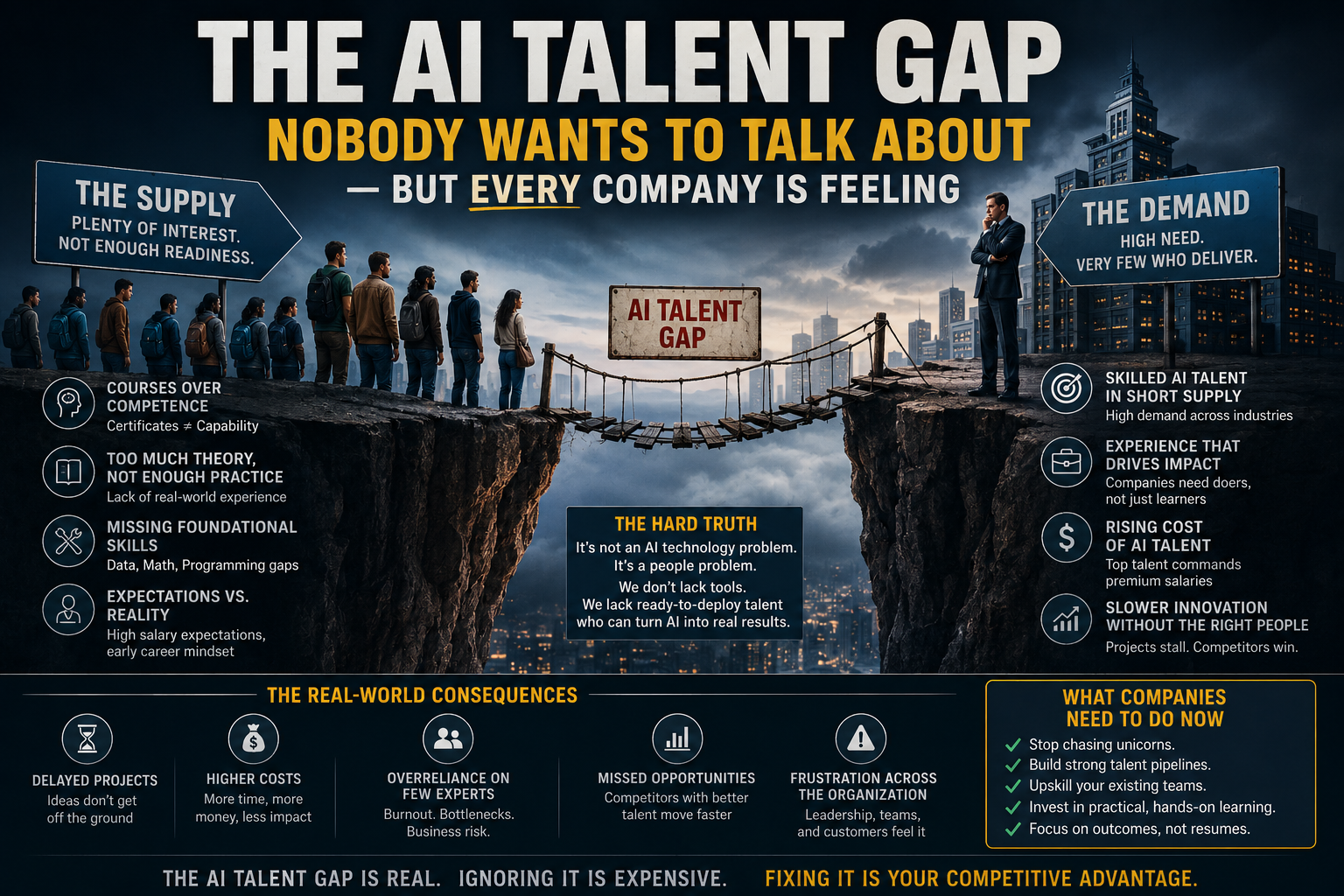
But this time, there’s a twist that the previous waves didn’t have, and it’s sitting quietly at the centre of nearly every boardroom conversation happening right now: the people needed to build this future don’t exist in large enough numbers. Not even close.
We’re not talking about a modest hiring challenge where recruiters need to widen their net or offer a slightly better package. We’re talking about a structural, systemic, honest-to-goodness talent gap that is forcing companies — from Fortune 500 giants to ambitious mid-market firms — to either slow down their AI ambitions, overpay dramatically for the talent they can access, or quietly lower their expectations about what “AI transformation” actually means in practice.
The number that keeps coming up in workforce reports and industry surveys is striking: roughly 40% of open AI roles globally simply cannot be filled with the talent currently available in the market.
That’s not a pipeline problem.
That’s not a compensation problem.
That’s a generation problem — and it’s going to take a generation to solve.
Why Is This Happening Now, Of All Times?
The honest answer is that demand exploded faster than any education system or training pipeline could realistically respond to.
As recently as 2020, AI hiring was largely confined to tech companies, research labs, and a handful of progressive financial institutions. The rest of the economy was curious about AI — but not exactly sprinting toward it.
Then everything changed in a compressed, almost violent period of time.
The release of large language models that could actually do useful things — not just parlour tricks — shifted AI from a technical curiosity to a boardroom imperative. CEOs who had previously nodded politely through AI presentations suddenly had investors, competitors, and customers demanding to know their AI strategy.
Budgets got unlocked. Hiring mandates went out.
“We need an AI team” became the business equivalent of “we need a website.”
But here’s the problem:
You can’t build a machine learning engineer in a quarter.
You can’t just hire a large language model specialist like a project manager.
These roles require deep, layered expertise — mathematics, statistics, software engineering, domain knowledge, and increasingly, an understanding of how to align AI behaviour with real-world business outcomes.
That combination takes years to develop.
And the global pipeline of people who have developed it is significantly smaller than the demand that now exists.
The education system didn’t get the memo in time. Universities are still graduating cohorts trained on curricula designed before the current generation of AI tools existed.
The gap between academia and industry has never been wider — or more consequential.
It’s Not Just the Big Names Fighting Over the Same Pool
There’s a common assumption that the AI talent crisis is primarily a problem for mega-tech firms — that it’s a bidding war between giants.
That’s only partially true.
Yes, compensation for top AI researchers has reached extraordinary levels.
Yes, six-figure signing bonuses are real.
But the more urgent problem is happening in the middle of the market.
These are companies that don’t need world-class researchers — but do need practical AI engineers who can:
- Fine-tune models
- Deploy them
- Integrate them into real systems
This is the talent companies assumed would be easier to find.
It isn’t.
- A manufacturing firm building predictive maintenance systems.
- A healthcare provider automating documentation.
- A retailer is developing recommendation engines.
None of them needs frontier AI, scientists.
But they all need people who can make AI actually work in messy, real-world environments.
That person is currently extremely rare.
The Real Gap Nobody Talks About
It’s not the frontier researchers.
It’s the mid-level AI implementers — the engineers, MLOps specialists, and AI product managers — who bridge the gap between research and business value.
This is where the shortage is most severe — and least discussed.
The Roles That Are Hardest to Fill — And Why
Not all AI roles are equally difficult to hire. The gap is deepest in specific areas:
→ MLOps and AI Infrastructure Engineers
The people who deploy, monitor, and maintain AI systems in production are extraordinarily rare. Training a model is one thing. Running it reliably at scale is another discipline entirely.
→ AI Product Managers
These roles require understanding both technical systems and unpredictable user behaviour. Traditional product experience isn’t enough.
→ Accountable AI / AI Ethics Specialists
With regulation and scrutiny rising, demand for expertise in bias, safety, and fairness is surging. Supply is minimal.
→ Domain-Specific AI Engineers
Professionals who combine AI expertise with fields like healthcare or law are incredibly valuable — and incredibly rare.
What Companies Are Actually Doing About It
Faced with this gap, organisations are responding in a few ways:
1. Competitive Overpricing
Throwing money at the problem. It works short-term — but doesn’t increase overall supply and creates internal pay imbalances.
2. Internal Upskilling
Training existing employees and transforming them into AI roles like data analysts, engineers, and statisticians slowly, but far more sustainably.
3. Strategic Partnerships
Collaborating with universities and training experts to build talent pipelines.
None of these is going to fix this issue quickly. But they reflect a shift toward long-term thinking.
The companies that will succeed aren’t the ones paying the most today —
They’re the ones building talent continuously.
The Uncomfortable Thing the Industry Needs to Hear
There’s a comforting belief that this gap will fix itself in a few years.
It probably won’t.
Because AI isn’t standing still.
The skills needed today won’t be the same in 2028.
This isn’t a backlog problem.
It’s a moving target problem.
Training more people on today’s tools won’t solve tomorrow’s needs.
What actually helps close the gap over time:
- Faster, adaptive education systems
- Companies investing in talent development
- Better tools lowering the barrier to entry
- Realistic expectations around AI transformation
The Bigger Picture
The AI talent gap isn’t just a hiring issue.
It’s a strategic inflection point.
It will determine which companies — and which economies — lead the next decade.
Organisations that treat it as a structural challenge will adapt.
Those who treat it as a short-term recruitment issue will continue:
- Competing for the same talent
- Driving up costs
- Burning out teams
- Falling short of expectations
Forty percent of AI roles going unfilled is not a statistic to ignore.
It’s a signal.
The real question is:
Are enough people actually listening?

