

A NA LYS I S · U K L A B O U R & M I G R AT I O N · M AY 2 0 2 6
T R E N D I N G · L A B O U R M A R K E T
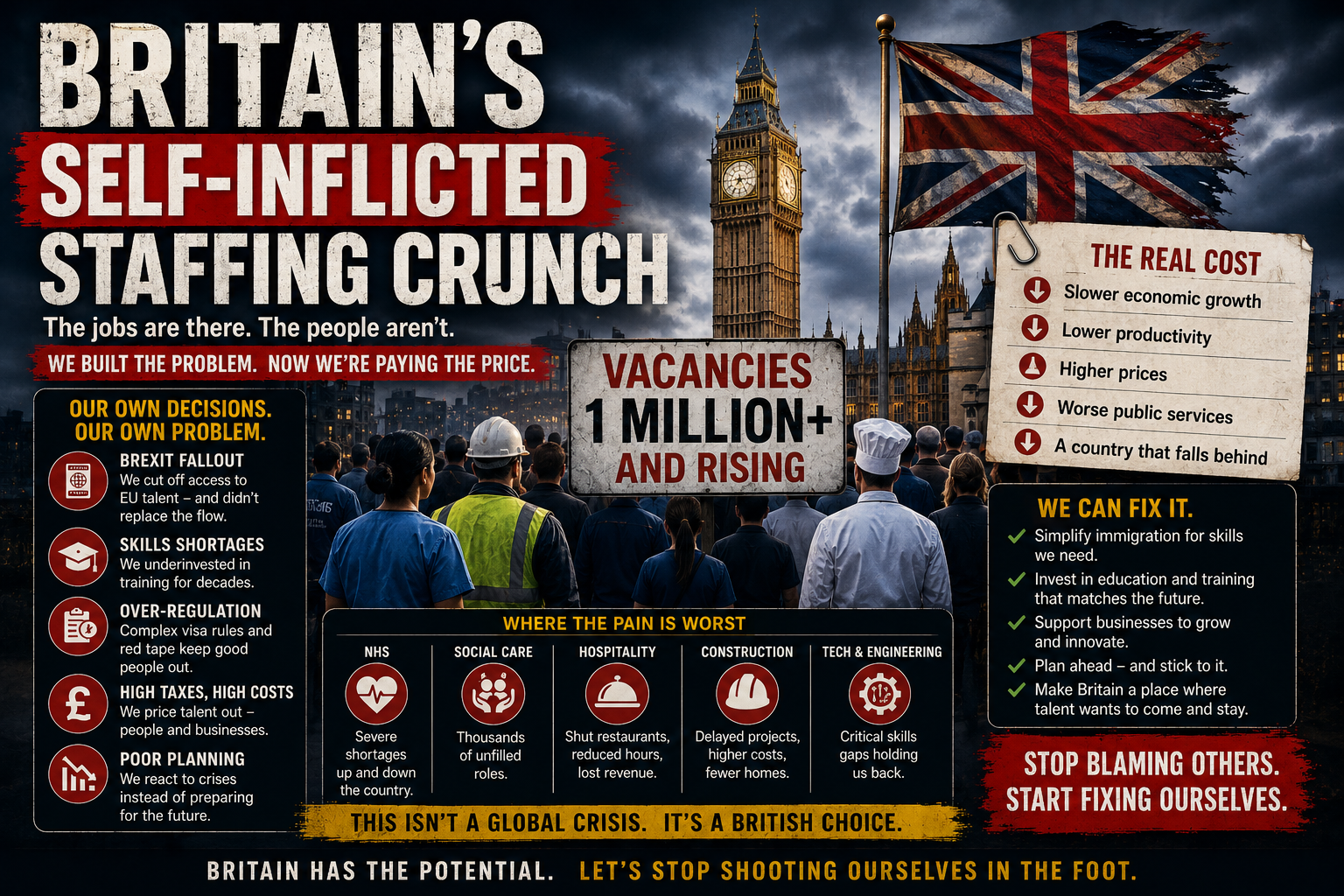
There’s a particular kind of problem that governments create by solving the wrong
problem at the wrong time. Britain, in the spring of 2026, is living through one of
those moments.
The headlines have been dominated by the Iran war and the energy shock that
came with it — spiking gas prices, a nervous Bank of England, ination creeping
back above 3%. But running quietly beneath all of that is a story that could prove
just as damaging to the long-term health of the UK economy: a stang crisis that
the government didn’t just fail to prevent, but actively engineered.
Over the past twelve months, Whitehall has pushed through the most aggressive
immigration reset in post-Brexit Britain. The intent was to slash net migration
numbers and force employers to invest in domestic talent. The result, in the short
term at least, is something closer to a labour market caught between two res.
What Actually Changed — and How Fast
The pace of the reforms has been striking. July 2025 was the inection point. That
month, the government raised the minimum salary threshold for Skilled Worker
visas from £38,700 to £41,700. It also eliminated approximately 180 occupations
from the eligible roles list by requiring applicants to hold a degree-level
qualication — something many critical mid-skill workers simply don’t have and
never needed. And it did something that the care sector had been dreading for
months: it shut the door entirely on overseas recruitment for care workers.
Not reduced. Not restructured. Closed. As of July 22, 2025, no new care worker
visas from abroad. A sector that had leaned heavily on international recruitment —
over 58,000 care visas were granted in 2022 alone — was told to nd another way.
50%+
DROP IN HEALTH &
CARE WORKER VISA
APPLICATIONS SINCE
REFORMS
36%
FALL IN SKILLED
WORKER VISA
APPLICATIONS YEARON-YEAR
–29%
UK JOB POSTINGS
BELOW PRE-PANDEMIC
BASELINE, MAY 2026
Alongside this, the government proposed to treble the qualifying period for
indenite leave to remain — from ve years to een. Workers who had uprooted
their lives and moved to the UK on the explicit understanding that they’d be on a
path to settlement aer ve years now found themselves facing a retrospective
change that UNISON called “morally wrong.” The union’s assessment of the care
workforce was blunt: breaking point.
The numbers speak to the scale of the reaction. Home Oce gures from January
2026 showed Health and Care Worker visa applications had plummeted by more
than half. Skilled Worker applications dropped 36% year-on-year. Sponsor licence
revocations hit record highs — 767 revoked in just the second quarter of 2025,
leaving thousands of migrant workers scrambling to nd new employers within 60
days or face removal.
The Care Sector: Borrowed Time, Broken Pipeline
In social care, the consequences aren’t theoretical. They’re already being felt in
delayed discharges, overstretched rosters, and providers quietly turning down
new service contracts because they don’t have the sta to honour them.
The logic behind closing the care route wasn’t entirely without merit. There had
been genuine and well-documented abuse — ghost workers, exploitative agencies,
employers pocketing visa sponsorship fees from the very workers they were
supposed to be helping. The government was right to want that cleaned up. But
shutting the route entirely rather than regulating it more rigorously was the
equivalent of burning down a house to deal with a mould problem.
“Care providers have leaned on overseas workers to ll roles that
domestic workers often won’t take due to low pay and challenging
conditions. Closing that pipeline without building a domestic
alternative is not a strategy — it’s a gamble.”
— INDUSTRY ANALYS I S, SPRING 2 0 2 6
The domestic alternative the government is banking on — better pay, improved
conditions, workforce development plans — exists largely on paper. Building a
domestic care workforce takes years. The vacancies exist now. There were already
an estimated 152,000 care vacancies in England in 2022/23. The reforms haven’t
created a pipeline to replace international workers; they’ve simply removed the
existing one.
The Tech and Professional Sectors: Death by
Threshold
In IT and the professional services world, the crisis looks dierent but is no less
real. The government’s decision to exclude mid-skilled tech roles from the
standard Skilled Worker route unless they meet the new RQF Level 6 (degreeequivalent) threshold has created a peculiar situation: companies can hire senior
engineers and senior data architects, but struggle to bring in the mid-level
technical talent — engineering technicians, systems analysts, skilled coders
without degrees — who do much of the actual work that keeps businesses running.
The Temporary Shortage List introduced in mid-2025 was meant to oer a pressure
valve. In practice, it’s a narrow, time-limited route with signicant strings
attached. Workers on the TSL can’t bring family members to the UK. They get no
salary threshold discounts. And the whole mechanism is under review by the
Migration Advisory Committee, with no guarantee it survives beyond 2026.
For tech businesses thinking about multi-year workforce planning, that’s not
reassuring. Hiring someone on a route that might not exist in eighteen months is a
risk most HR directors won’t take lightly. The result has been a quiet but visible
shi — some companies are increasing their near-shore footprints in Europe,
others are accelerating internal automation and AI adoption, and a growing
number are simply competing more ercely for the shrinking domestic pool,
which is pushing salaries up in exactly the sectors where the government wanted
wages to remain competitive.
The one bright spot, ironically, is AI hiring itself. Job postings mentioning articial
intelligence roles are sitting 127% above pre-pandemic levels, according to Indeed
Hiring Lab data. The demand for people who can build, manage, and implement
AI systems is surging even as the broader jobs market retreats. But that’s a longgame benet — it doesn’t solve the immediate gaps in nursing, care, construction,
and mid-level IT roles that employers are staring at right now.
Enter the Iran Shock: Terrible Timing
And then, in late February 2026, Israel and the United States launched strikes
against Iran. Iran responded by announcing the closure of the Strait of Hormuz.
Energy markets lurched. Global gas prices spiked. And the UK — a net energy
importer that the IMF had already identied as the G7 economy most exposed to
international gas price uctuations — took a particularly sharp hit.
The economic consequences have moved fast. UK job postings fell around 8% from
the outbreak of the conict to early May 2026, compounding an already-depressed
hiring market that was sitting 29% below its pre-pandemic baseline. Vacancies fell
to their lowest level since April 2021. Ination climbed to 3.3% in March. UK
ination is forecast to breach 5% in the second half of 2026 if the disruption
persists.
For employers, this creates a deeply uncomfortable squeeze. Energy costs are
rising. Input costs are rising. Consumer condence is shaky. The Bank of England,
which had been on a clear path toward rate cuts, is now frozen — nancial markets
are pricing in the possibility of rate hikes instead. The cheap credit that SMEs had
been counting on this year now looks out of reach.
“UK employers were already cautious before the outbreak of war
in Iran. e subsequent spike in global energy prices is set to
intensify cost pressures facing businesses at precisely the
moment their access to international talent has been cut o.”
— INDEED H IRING LAB, APRIL 2 0 2 6
In this environment, the migration crackdown isn’t just a workforce problem — it’s
a cost problem. The Immigration Skills Charge jumped in December 2025. The
Certicate of Sponsorship fee more than doubled, from £239 to £525. A company
that used to be able to sponsor a skilled overseas worker for a manageable cost is
now looking at a signicantly heavier bill at a time when margins are already
under pressure from energy prices and a soer consumer market. The rational
response for many SMEs, particularly those outside London where salary
thresholds are even harder to meet given regional pay scales, is to simply stop
sponsoring.
The Structural Trap Britain Has Built for Itself
Here’s the uncomfortable truth sitting underneath all of this: the UK government
has created a policy that makes sense as a political headline but struggles as
economic management.
Net migration for the year ending June 2025 fell to 204,000 — a 69% drop from the
649,000 recorded the previous year. The Home Secretary called it proof that the
“era of easy migration” was over. On its own terms, the policy is working. The
numbers are going down. The political objective is being met.
But the sectors that relied on international recruitment — care, construction,
hospitality, mid-level IT, logistics — didn’t get that policy signal three years ago and
spend the intervening time building robust domestic pipelines. They got it in July
2025 and were told to x it immediately. That’s not how labour markets work. You
cannot conjure a generation of domestic care workers through a policy
announcement. You cannot retrain a lorry driver or a soware technician
overnight. Workforce transformation is a decade-long project, and the government
is treating it like a quarterly earnings call.
The Migration Advisory Committee’s review of salary thresholds — published in
December 2025 — actually oered some nuance the government would do well to
heed. The MAC proposed returning to 25th percentile salary data for occupationspecic thresholds, and agged concerns about new entrant discounts. These are
not radical suggestions. They’re a signal that even the body tasked with advising on
immigration policy thinks the current calibration is too blunt.
What Comes Next: Three Scenarios
The optimistic read is that the Iran conict ceases, energy prices stabilise, and the
MAC review leads to a more nely tuned regime that keeps thresholds high
enough to protect domestic workers but exible enough to allow genuinely
shortage occupations to access international talent. In this scenario, the
disruption is painful but temporary.
The baseline read is a protracted period of understang in care and mid-skill
sectors, rising pressure on NHS discharge pathways, continued talent outows
from the UK as skilled migrant workers who already live here reassess their longterm futures against a 15-year settlement horizon, and a slow-burn erosion of
employer condence in UK-based growth.
The pessimistic read involves the Iran conict dragging into late 2026, ination
breaching 5%, the Bank of England being forced to tighten rather than ease, and
the combined weight of energy costs, reduced labour supply, and tighter credit
pushing the UK into the technical recession that the European Central Bank is
already warning about for its most energy-exposed economies. In that scenario,
the migration crackdown becomes one chapter in a longer story about why the UK
economy underperformed its peers across the 2020s.
The Bottom Line
The UK is not the rst country to discover that immigration policy and economic
policy are harder to decouple than politicians like to pretend. But the current
situation is particularly sharp because both pressures — the policy shock and the
external shock — are hitting simultaneously, and in the same direction.
Employers are turning cautious. Vacancy numbers are falling. Migrant workers
who are already here are reassessing whether the UK still represents the
opportunity it once did. And the sectors most exposed to all of this — care,
construction, mid-level tech — are the ones the UK cannot aord to have running
below capacity as it navigates an already dicult economic moment.
The government made a political promise to cut migration, and it has delivered on
it. The question is whether the price of that promise — paid not in votes but in
hospital beds and understaed care homes and slower project timelines and tech
companies that can’t quite hire the people they need — is one the country was
actually prepared to aord.
Right now, with energy prices rising and hiring demand falling, Britain is nding
out the answer in real time. And so far, it’s not entirely reassuring.
ANALYSIS · UK LABOUR & MIGRATION · PUBLISHED MAY 6, 2026 · ALL DATA SOURCED
FROM MIGRATION OBSERVATORY, INDEED HIRING LAB, ONS, AND PARLIAMENTARY
RESEARCH BRIEFINGS.

