
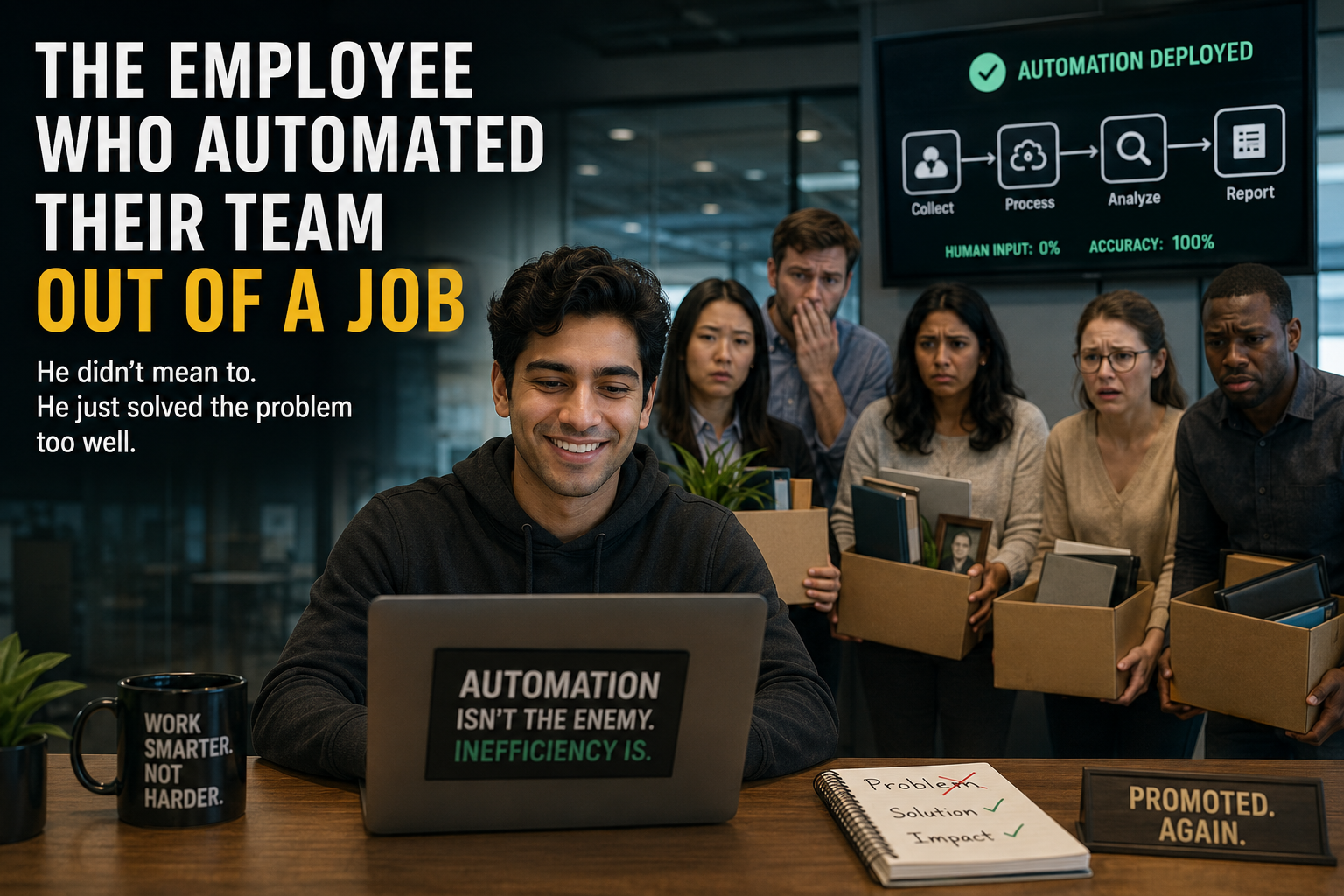

An employee spends six months quietly building AI workflows in the background—scripts, automations, prompt chains, and integrations. Nothing dramatic, just methodical work done after hours without announcement. By the time anyone notices, 60% of their team’s daily output is being handled by tools they built alone. A team of six has become, functionally, a team of one.
What happens next is where the story splits, and where the real debate begins.
In some versions, the employee is celebrated with a bonus, a promotion, and public recognition for driving innovation. In others, the same employee is let go—not for poor performance, but because leadership realises they now have justification to eliminate multiple roles.
This arc has been appearing repeatedly across online discussions and tech communities. It has become a symbol of a deeper workplace tension: if you innovate your way into efficiency, do you get rewarded, or do you simply create a case for redundancy?
And if the answer is the latter, why would anyone disclose what they have built?
The Innovator’s Risk Is Real and Understated
This dilemma exposes a rarely discussed reality of AI adoption: employees are increasingly using AI tools in secrecy.
According to a study carried out on the Medium platform back in January 2026, the reason for such behavior is not unethical but rather unclear, and a lack of psychological comfort. Secrecy is actually a reasonable reaction in situations when companies publicly praise innovation as an effort, and then silently use their efficiencies as an excuse for downsizing staff. In the absence of any clear policies related to innovation and recognition of innovators, employees have started acting out of the spotlight.
The current workforce statistics have confirmed such concerns. According to an article from After the Grind, about 30,700 tech jobs were slashed during the first months of 2026, but only 1,430 were related to any introduction of AI, which meant that 29,000 were unrelated to artificial intelligence despite having been called something else in their respective press releases. Positive market reactions after downsizing the workforce have made the situation even more complex.
The message being absorbed by employees is direct: efficiency is rewarded at the organisational level, but not always at the individual level.
The AI-Washing Problem
While considering employee responsibility regarding ethical issues, one needs to focus on organizational processes first of all.
A growing number of companies are presenting layoffs as an AI-driven transformation, even when automation plays a limited role. This phenomenon, often referred to as AI-washing, allows organisations to position cost-cutting decisions as a forward-looking strategy rather than a financial necessity.
As Quartz’s reporting article cited in After the Grind, of 500 eliminated positions at a typical firm, perhaps 150 are genuinely attributable to automation of specific back-office functions—the remaining 350 reflect shifting market conditions and strategic decisions that would have happened with or without generative AI.
From a communicative perspective, it makes perfect sense. Communicating layoffs acts as an innovation signal to investors, but communicating them due to falling demand indicates instability. However, there are many repercussions to this kind of narrative.
Employees who see such a trend start doubting the value of innovation, realizing that instead of being rewarded for their efforts, the innovator is taken advantage of and rendered disposable. These beliefs have a direct effect on employees’ behaviour. In turn, when trust decreases, transparency decreases.
The Replacement’s Mathematics
The monetary logic behind such decision-making is rather brutal.
As reported in a blog post titled Engineering Playbook on Medium in April 2026, one senior engineer explained the calculation in a spreadsheet that led to his team’s demise: one US-based senior engineer valued at $265,000 versus another senior engineer offshore with extensive AI tooling valued at about $43,000 per year—an annual saving of $221,800 per replacement. With a team of eleven engineers, the savings were estimated to be $2.4 million annually.
The argument made by leadership was revealing: “With Claude Code and Cursor, the productivity gap closed.
Why pay $265K when $43K gets us 85% of the output?”
This is not a story about AI replacing engineers. It is a story about AI combined with lower-cost labour replacing expensive engineers. The tools work. The question is who operates them and at what price point.
What the Fear Often Misses
While individual stories of automation-driven displacement are compelling, broader economic data present a more nuanced picture.
A 2026 survey of nearly 6,000 executives cited by CIO and referenced in Medium conveyed that 90% reported no measurable impact from AI on employment or productivity during the previous three years. Organisations are experimenting with generative tools, but large-scale operational changes remain limited. Even the intensity of usage is far lower than public discourse suggests—among executives, the average AI usage is roughly one and a half hours per week, typically for light tasks such as text generation or summarising documents.
Research from the National Bureau of Economic Research suggests generative AI can narrow up to 75% of productivity gaps between workers with different education levels. However, closing a productivity gap doesn’t mean building true professional expertise. Expertise developed through experience, mistakes, and exposure to real-world problems over time is essential and a game-changer for organisations that believe in replacing professionals with AI.
Historically, technological revolutions have followed a consistent pattern. While certain roles become obsolete, new categories of work emerge simultaneously. The average effect has not been sustained mass unemployment; it lies in structural transformation. This does not diminish the impact on individuals whose roles are affected just because of AI interference in their professional lives, but it also highlights the capabilities and learning power of that particular employee. The central concern is not whether AI will eliminate jobs entirely, but how the benefits of increased productivity are distributed.
The Recurring Problem
When professionals perceive that innovation leads to their own elimination, they respond predictably.
As per the Writer 2026 State of Enterprise AI survey cited in The Crux, nearly 29% of employees are quietly trying to undermine AI systems—feeding company data into public models, ignoring mandated tools, or producing deliberately low-quality AI output to make the system appear broken.
Among Gen Z workers, that figure rises to 44%. Sixty percent of executives respond by threatening to fire them.
The loop becomes self-reinforcing: AI delivers efficiency, workers sabotage it, leaders threaten retaliation, and the cycle repeats. At no point does anyone in the leadership team ask the question that would end it: What happens to our people?
According to Deloitte’s 2026 Human Capital Trends report referenced in the same analysis, tech-first organisations—those that lead with tooling and treat workforce design as an afterthought—are 1.6 times more likely to miss their AI returns. Nearly 80% of enterprises report significant adoption challenges, despite having the tools deployed.
The Burnout Equation
If layoffs were purely about efficiency gains, we might expect the remaining workforce to stabilise and productivity to increase. Instead, another pattern has emerged.
As per Medium’s cited analysis about the staffing industry, nearly 46% of technology professionals reported feeling burned out in 2026, compared to 31% in 2024. The reason for this was quite simple: the work did not disappear after the layoffs. It was redistributed among the remaining team members.
Many professionals now face a strange equation: the responsibilities of several roles, supported by AI tools, but still carried by a single human operator. Not everyone is willing to accept this trade-off. This creates a paradoxical situation where layoffs coexist with voluntary exits—and when teams operate permanently at maximum capacity, innovation disappears.
The Question That Raises Ethical
The ethical dilemma is frequently misrepresented.
The question is not simply whether it is right or wrong to automate team workflows without disclosure. The answer depends largely on the organisational environment.
In companies where innovation is consistently recognised and rewarded, transparency is the rational choice. Employees who effectively leverage AI in such environments often experience accelerated career growth. However, in organisations where efficiency gains historically result in workforce reductions, withholding that information becomes a rational act of self-preservation.
The more relevant question is: What kind of organisation are you, and have you made that clear enough for employees to trust the outcome of their innovation?
As one analyst framed it: organisations need to answer four questions in writing, with a name attached, before AI rollouts scale—which roles absorb reclaimed capacity, what fraction of freed hours goes to value creation versus cost reduction, what sequence is followed before exit options, and what metrics leadership will actually track.
Without a clear and credible answer, the risk associated with visible innovation remains unresolved.
The Bottom Line
The story of the employee who automated their team is not about individual ethics. It is a reflection of organisational trust.
AI is not eliminating work at scale. It is restructuring how work is performed and slowing the rate of new hiring in certain areas. This transition is gradual, uneven, and complex.
The defining factor for both individuals and organisations will be the ability to align stated values with actual outcomes. Until organisations close the gap between promoting innovation and protecting those who drive it, similar stories will continue to emerge.
Not because employees are uncertain about what is right, but because organisations have not made it safe to do the right thing.
About Timecode Technologies!
Timecode Technologies supports organisations in building AI-ready teams and developing workforce strategies that make innovation sustainable rather than disruptive.
For more information, visit: timecodeglobal.com

